Tuesday, 11 February 2014

Nonprofit helps fight poverty in Mexico with microloans

,

A nonprofit organization in Mexico called Envia is helping women in poverty by providing micro loans. Envia founder Carlos Topete told CNN that he was inspired to start the organization by 2006 Nobel Peace Prize winner Muhammad Yunus, who pioneered the idea of micro loans, small loans for poor borrowers with a zero rate of interest.
The program was launched in 2008 with 12 women and operating with Topete's own money. In three years, it has grown to serve 260 women in five different communities in the valley of Oaxaca. CNN's Rafael Romo reports.

Watch this video

Friday, 27 December 2013

How to bust through barriers to business growth

Most businesses fail to scale up. Here are three obstacles you need to blast through if you want your business to grow.

By Verne Harnish


FORTUNE -- Most businesses fail to grow -- with a vast majority remaining tiny, one- or two-person shops. I'd like to see more reach their potential. Even if a business isn't destined to be the next Google, Amazon, or Facebook, it can still become a thriving, mid-market company. Here are three barriers to growth you need to blast through if you want your business to scale up.
1. The inability of the CEO to let go. This is the primary reason that a paltry 5% of businesses break the $1 million revenue mark and only about one in eight of those reach $10 million, according to recent data. Either the owner thinks he's the only person capable of getting things done or tried to delegate once but got burned by a bad hire and can't trust anyone again.
MORE: Who had the worst year in Asia? Obama.
The only way to get through this is to find people who can do things better than you and who don't need to be managed. Will the folks you hire mess up sometimes? Yes, but you've got to push past that.  If you suffer the short-term challenges of bringing someone up to speed, your life will get a lot easier and your company will be able to tackle bigger projects and contracts.
2. Being a cheapskate. In the startup phase, when you're not making much money, you've got to be a bit of skinflint, but there comes a point where you have to invest in your business or it won't grow. I'm not suggesting that you spend yourself silly, but if you want to grow, you're going to have to upgrade some of your systems, whether that means your accounting software, phones, or IT infrastructure. You'll need better office space than your garage.
Probably the most important step you can take is to find a great accountant or CFO. Most entrepreneurs think they should spend money on making or selling stuff, like they did in the startup phase. However, as your business grows, you need detailed data about where you're making money -- or not -- to make the right decisions. The figures on your balance sheet can hide a multitude of problems. A good accountant will help you figure out how much money you're bringing in by customer, by sales person, and by location. That way, if your company is a wreck, you'll know where to fix things -- so you don't build an even bigger mess. Hiring a great accountant or CFO will cost you, but it will help you make money in the long run.
3. Not adjusting to unforgiving market dynamics. If you're doing things right and your business starts to grow, you're going to find yourself with more competition. Copycats will come out of the woodwork. The big guys will realize you're on to something, get angry when you ruin their quarter, and try to knock you down so you don't steal any more market share. Meanwhile, as your customers do more business with you, they're going to want price concessions.
MORE: The dumbest deals of 2013 
It's easy at this stage to get sucked into day-to-day operations, but this is precisely when you need to start paying more attention to market-facing activities and delegate internal matters to a strong team. Your job as CEO is coming up with the right strategy to keep growing and to adapt it to changing market conditions. It's only when you are willing to adjust your mindset that your company will be able to grow.

Monday, 21 October 2013

Turn Your Passion For Cooking into a Career as a Chef

Most ladies and even men say their passion is cooking. Unfortunately only a few have considered it as a career. Good news!  you can have a lucrative career as a chef in the world of today.
If you’re thinking about a career as a chef, but aren’t quite sure how to go about it, look no further. We’ve broken down what you need to do into three basic steps that; with the right training, you’ll be able to climb.
Chefs get jobs internationally at the world’s exotic locations and at private residencies of the world’s richest/government leaders. And oh, chefs make a lot of money than you think. Between the world’s top 10 earning chefs is a combined worth of around $280 million dollars. And the average salary for a pastry chef (lowest level) with an international culinary school training is $34,000 – $52,000 annually. That’s top dollar for doing what you would’ve done in your house for free!
top-culinary-school-dubia

How to Start a Chef Career

Step #1: Get a Culinary Degree

It takes a lot to be a chef. Chefs have to know how to sear a piece of tuna, fresh asparagus, and reduce a sauce down to perfection – sometimes all at once. In addition, they must know how to oversee an entire kitchen staff, handle knives without losing any fingers, and keep the refrigerator at the right temperature so the meat doesn’t spoil and the dessert don’t freeze.
To learn all of this (and a few other tricks that come in handy), most chefs start their career by going to culinary school. There, you’ll get the hands-on experience you need to make your way around the kitchen.
The ICCA in Dubai is one of the best culinary training schools in the world. An ICCA Diploma costs on an average $12,000 and that covers tuition, visa, accommodation and a salaried internship. Learn more
Ready to start a Culinary Career?
Request information on a culinary chef diploma program in Dubai by clicking here.

Step #2: Get Some Experience Under Your Belt

Once you graduate from culinary school, next thing to do is to get an internship for some experience (ICCA assures this). First, you have to prove that you can hold your own in front of a hotel guest roll on a busy Friday night.
When you graduate culinary school, use the connections you made there to find a position as a chef de partie, also known as a station chef or line cook. Yes, it will be grueling and consists of long hours, but it’s a great way to get the experience you need. Many restaurants rotate their line employees through different stations, which allow you to perfect your skills and handle any complicated order that comes your way.
Culinary schools like the ICCA in Dubai, UAE actually help you get immediate internships at the world’s best hotels such as Burj Al Arab, The Atlantis and the Grand Hyatt, to mention a few.

Step #3: Work Your Way Up

Once you feel confident in your culinary skills, what’s next? There’s a variety of positions underneath the executive chef that will allow you to climb the culinary ladder.
Expediters work to coordinate all the different entrees and ensure that they come out on time. (They’re sort of like an orchestra conductor, but of the kitchen.) Head cooks oversee and supervise the other workers on the line. And Sous chefs are second-in-command to the executive chef, ordering inventory, helping with menu creation, and running the kitchen in the chef’s absence.
Any of these positions will give you the leadership and management experience you need to eventually become an executive chef yourself.
Ready to start a Chef Career?
Request information on a culinary chef diploma program in Dubai by clicking here.

best-chef-school-dubai
Turn your cooking passion into a career
Request information on a culinary chef diploma program in Dubai by clicking here.

Friday, 16 August 2013

The man steering Fidelity Magellan back on course

fidelity investments

With over $14 billion in assets, Fidelity Magellan is a fairly large, widely owned portfolio. But in its heyday, Magellan was quite simply Wall Street's best brand -- a living advertisement for the notion that a gifted fund manager can consistently beat the market.

Peter Lynch, who ran the fund until 1990, earned an annualized return of 29% over his 13-year tenure. Subsequent managers failed to repeat his success, and under the last one, Harry Lange, performance was sometimes dismal.

Can new manager Jeffrey Feingold turn this ship around?
How the giant fell
The history of Magellan (FMAGX) offers a lesson: A fund's past successes can be a burden on current owners.
Lynch's legacy kept the fund popular through the 1990s, and it ultimately hit a then-record $100 billion. Once a fund is that big, however, it can get trapped in a box.
The key to Lynch's success, says mutual fund consultant Geoff Bobroff, was that he could bet big on just about anything. A giant fund, by contrast, can have a hard time finding enough winners on which to spread its billions.
Related: Invest your way to $1 million
One Magellan manager, Robert Stansky, made the fund more like the S&P 500. Lange made big strategic shifts, such as a badly timed bet on financial and foreign stocks coming into 2008. By 2011, as investors left, size wasn't such a problem.
So far, so good
Fund manager Feingold beat the majority of funds in Magellan's large-growth category in 2012, his first full year on the job, and he's so far on track to win again this year. This builds on Feingold's solid record running Fidelity Trend (FTRNX), another fund that focuses on blue chips with high earnings growth rates and comparatively steep valuations.

How to make a million dollars
  Feingold says he finds growth in three "buckets." Fast growth, like recent top holding Google (GOOG, Fortune 500); pretty good growth with a strong financial position, such as Coca-Cola (KO, Fortune 500) (KO); and cheap stocks that are improving.
That last category has led Feingold to hold more than his rivals in financial stocks. "They've gone from bad to less bad," he says. In this case, the timing worked: Financials are up over 38% in the past year.
Looking for small edges
Magellan's smaller size gives it more flexibility now -- the portfolio even has 5% in small stock. Still, under Feingold, "It's a fund that isn't so different from its benchmark," says fund researcher Russel Kinnel of Morningstar.
Think of Magellan as a core stock fund with a growth tilt. Feingold has held less in tech and more in financials than the typical growth fund. So Magellan may not outperfom as much when the market favors classic growth stocks.
Related: Want $1 million? Protect your portfolio
That raises the question: Should you pay the added expenses for a portfolio not wildly different from an index fund? It helps that Magellan's expenses are just 0.46% a year. But if the fund really comes back, it's allowed to charge a performance bonus that could add a bit to its cost. 
 
 Nnamdi Armstrong
C.E.O 
Sloane International Investments Ltd
+23408162319833

Wednesday, 14 August 2013

China set to pass U.S. as top oil importer

china oil import

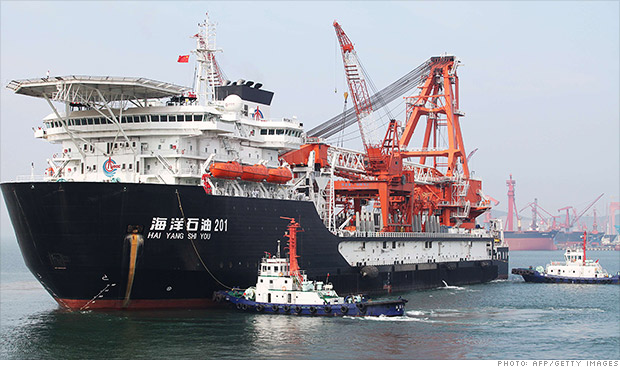
The rapid redrawing of the world's energy map is about to hit another milestone, with China overtaking the U.S. as the biggest importer of oil.

The Energy Information Agency expects China's monthly net oil imports to exceed those of the U.S. by October, and by next year on an annual basis.

"The imminent emergence of China as the world's largest net oil importer has been driven by steady growth in Chinese demand, increased oil production in the United States, and a flat level of demand for oil in the U.S. market," the EIA said in its latest outlook.
A boom in U.S. oil production is being driven by new technologies, such as hydraulic fracturing -- or fracking -- which are opening up huge reserves for development.
The Paris-based International Energy Agency has forecast that the U.S. could become energy independent by 2030, and the world's biggest producer seven years from now.
Related: U.S. oil boom causing energy upheaval
The U.S. oil boom is boosting the nation's level of reserves, reshaping global oil trade flows and driving up demand and salaries for experienced engineers.
And while China's breathtaking pace of economic expansion has slowed, its demand for oil to fuel a massive manufacturing sector is set to continue growing at a much faster pace than it can ramp up its own production.
Related: China, OPEC and the future of energy
China demand for liquid fuels will have grown by 13% between 2011 and 2014 to more than 11 million barrels per day, while its production will increase by just 6%, according to the U.S. EIA.
Fracking fight hits England
Over the same period, U.S. total annual oil production will have risen by 28% to nearly 13 million barrels per day, as demand hovers around 18.7 million, well below the 2005 peak of 20.8 million, the EIA said.

Nnamdi Armstrong
C.E.O 
Sloane International Investments Ltd
+23408162319833

Apple's store headache

apple store losing magic

Apple Stores are one of Steve Jobs' greatest legacies, but the retail business has been a headache for Apple lately.

The latest migraine: The friendly, t-shirt wearing retail workers helping you pick out your latest iPhone filed a class-action lawsuit late last month, suing the tech giant over unpaid wages.

Two former workers claim that they were required to wait in line for a manager to check their bags for stolen goods before leaving the store -- but after clocking out. Some days the wait was longer than five or ten minutes, which added up to $1,500 in unpaid wages per year for one worker, according to the lawsuit. Apple (AAPL, Fortune 500) Store employees typically make between $12 and $18 per hour.
That's small change for a company that has brought in more than $79 billion in sales so far this year. The lawsuit could damage Apple's sterling reputation, said Robert Passikoff, president of brand research consultancy Brand Keys.
"It begins to raise questions. And you don't want a question mark next to your brand," said Passikoff. "That jars people."
Apple did not respond to a request for comment.
Related story: An Apple store is worth as much as the White House
But Apple has been down this road before. A year ago this week, Apple began laying off recent Apple Store hires to make its retail operation leaner. The problem: Apple has been praised for its ubiquitous help, and the cuts were made smack in the middle of the busy back-to-school season.
Apple later reversed course and publicly admitted the layoffs were a "mistake." The company fired John Browett, its retail chief, two months later.
Sales at Apple Stores have also begun to sink, and visits are down. This past quarter, Apple Stores averaged 16,000 visitors per store each week, down from 17,000 during the same period a year earlier.
That's not a shock, considering Apple released a new iPad in March 2012 -- and hasn't updated it since. But here's a worrisome number: Per-store revenue fell 9% year-over-year, while Apple's overall sales were up 1%.
Meanwhile, AT&T (T, Fortune 500), Microsoft (MSFT, Fortune 500) and many others have attempted to replicate Apple's retail model. Though they've had varying degrees of success, the seamless shopping experience is no longer unique to Apple.
The Apple Store's success isn't something the company wants to mess with. Apple Stores are by far the most valuable retail spaces in the world measured by sales per square feet, according to industry publication RetailSails. Last year, they outpaced Tiffany's (TIF) in that measure by 40%.
But if Apple were to create a new vision for the Apple Store, it's not clear where that would come from. For now, the Apple Store is leaderless.
Apple has yet to find a permanent replacement for Browett, who only lasted fewer than 10 months in the job. He replaced Ron Johnson, who is largely credited with developing Apple's retail strategy. Johnson left for J.C. Penney (JCP, Fortune 500) in 2011 ... though he's currently available.


Nnamdi Armstrong

C.E.O 
Sloane International Investments Ltd
+23408162319833

Monday, 5 August 2013

Chinese producers benefit amid New Zealand milk scare

milk powder

Chinese dairy companies are basking in a rare moment. This time, they're not the ones under scrutiny for food safety -- it's a New Zealand firm.

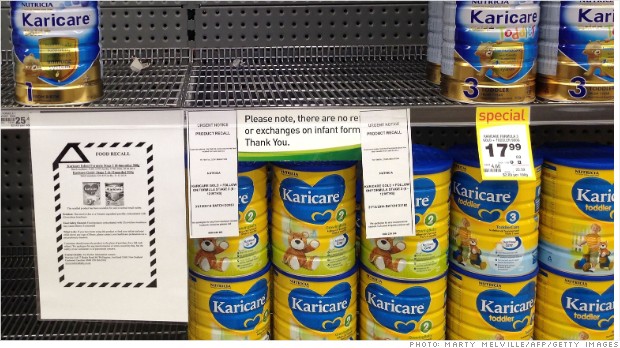
Over the weekend, the world's largest dairy exporter, Fonterra, revealed that some of its products were contaminated with a bacteria that could cause botulism. The bacteria was found in whey protein, produced by the New Zealand company, for sale to other companies for use in consumer products.

Now, China has suspended imports of some whey protein and milk-based powder sourced from Fonterra.
This isn't great news for New Zealand, as China is its top trading partner. But it's turning out to be a bit of a boon for some Chinese dairy and infant formula companies.
Guangzhou-based infant formula maker Biostime and China Modern Dairy both surged by 9.8% in Hong Kong trading. Yashili International closed up 2.5%. China Mengniu Dairy closed down 1.4%, erasing earlier gains.
At the same time, Want Want China, a company that sources most of its raw milk from Fonterra, tumbled 3.2%.
China has pledged to boost food safety measures after tainted baby formula killed at least six infants and sickened another 300,000 in 2008. Nearly all major Chinese makers of milk powder were found to be contaminated with the toxic chemical melamine. The additive caused the formula to appear to have a higher protein content.
Related story: China probes baby milk price fixing
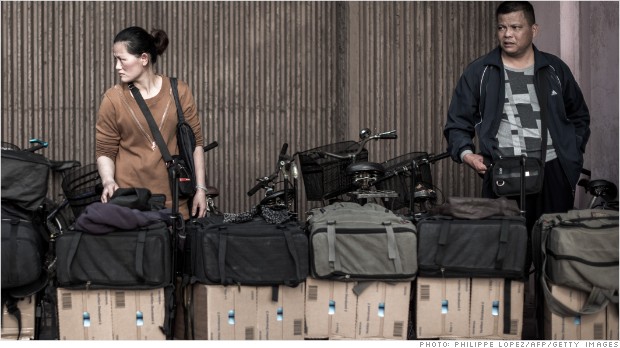
Chinese families, fearful of tainted formula, have been scouring the globe for milk they perceive to be safer. The rush has created shortages as far afield as the U.K. As a result, foreign baby formula brands such as Nestle (NSRGF) and Mead Johnson (MJN) have surged in popularity.
Not all foreign-sourced baby formula have continued to benefit from Chinese consumer preferences for non-domestic brands. Infant formula products from New Zealand have received additional scrutiny lately as Chinese companies have been buying up dairy farms in the country.
"People are saying they don't trust it any more than a Chinese source," said China Market Research analyst Ben Cavender. Consumers are becoming more concerned, Cavender said, that there's greater risk of "cutting corners, cutting costs" as Chinese businesses become more involved.
Last year, the New Zealand government approved the sale of 16 farms, including dairy farms, to Chinese developer Shanghai Pengxin Group.

 china infant formula
Nnamdi Armstrong

C.E.O 
Sloane International Investments Ltd
+23408162319833